Did you know that you can navigate the posts by swiping left and right?
Who subsidises my AI? 5.73 billion tokens later
11 Oct 2026
. category:
dev
.
Comments
#ai
#productivity
TLDR: From 5 September to 11 October 2026, I logged 5.73 billion tokens, mostly cached context; 11 October is partial. Subscriptions give me a huge discount against API prices; cheap Chinese models lower what I will pay for delegated work. Claude remains worth a premium as my trusted orchestrator.
I extracted the usage with:
npx ccusage -s 2026-09-05
All models: 5.73 billion tokens
| Category | Total |
|---|---|
| Reported total tokens | 5,726,005,355 |
| Costs priced by ccusage | $1,344.89 |
| DeepSeek actual spend | $17.38 |
| Report valuation plus DeepSeek spend | $1,362.27 |
| Output tokens | 35,054,182 |
| Uncached input tokens | 69,739,178 |
| Cache creation tokens | 52,786,474 |
| Cache read tokens | 5,568,385,447 |
| Sum of the four token categories | 5,725,965,281 |
| Difference in ccusage’s total counter | 40,074 |
This mixes API estimates with DeepSeek spend, not my bill. Gemma’s 978,819 tokens remain unpriced. The 40,074-token discrepancy is unresolved; the full model CSV sums to the category subtotal.
What I actually pay
ChatGPT Plus/Codex and Claude Pro list $20/month; GLM Lite lists $18, with a $12.60 offer. My receipts show €18/month for Claude, 80.49 PLN for ChatGPT, and $18 plus a separate $3 Z.ai payment. This 37-day snapshot spans billing cycles.
DeepSeek consumed $17.38 of a $20 top-up, leaving $2.62.
I also have Google AI Plus, but see no larger Antigravity allowance than free accounts. Its documentation distinguishes Pro/Ultra without giving exact Plus-versus-Free token counts.
China does not need to win every task
Western subscriptions look subsidised against retail API value; list prices reveal neither serving costs nor provider losses. DeepSeek’s off-peak cache reads cost about 1/67 of Opus 5.5’s.
Cheap delegated work already lowers what I will pay. If Chinese providers aim to deflate AI’s price premium, it is working in my workflow; their intentions and profitability remain unknown.
Anthropic is committing to gigawatts of infrastructure. Useful AI could still disappoint investors if willingness to pay falls faster than costs. For me, reliability justifies Claude’s premium; delegated work faces much stronger price competition.
Trust still has a price
I trust Claude the most. Codex made risky decisions without asking me. Cheap tokens save less when I must supervise every decision.
I kept Opus 5.5 orchestrating for a long time while learning, running compact roughly eight times. Sonnet 5.5 now leads, sometimes Opus; these expensive models delegate to subagents and collect results.
Most work concerned HOCON: lightbend/config, ekrich/sconfig and my hocon-fmt. Working mainly through Claude, I developed a skill for choosing models and reasoning effort.
Detailed usage analysis
For aggregation by model:
npx ccusage -s 2026-09-05 --json --breakdown
We ran the binary directly because npx was unavailable. These local Claude, Codex, OpenCode, Antigravity and Zcode logs cover unequal workloads: I have had Claude almost two weeks longer.
Cached context
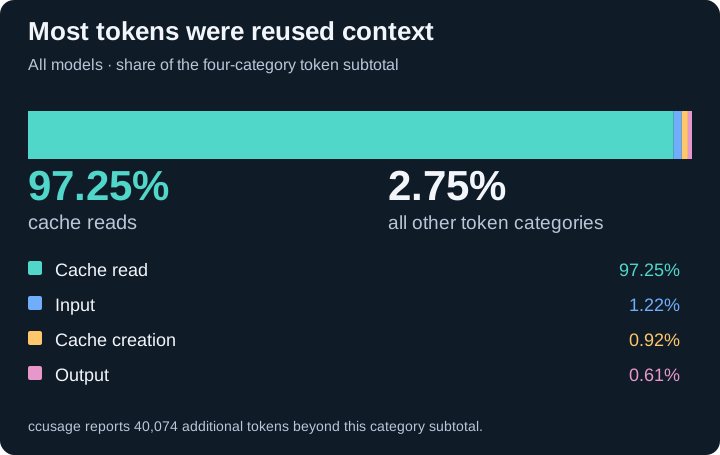
DeepSeek generated roughly 35% of recorded output. Cache reads represent 97.25% of the category subtotal and 98.52% of DeepSeek’s tokens: those billions mostly mean reused context.
How the mix changed
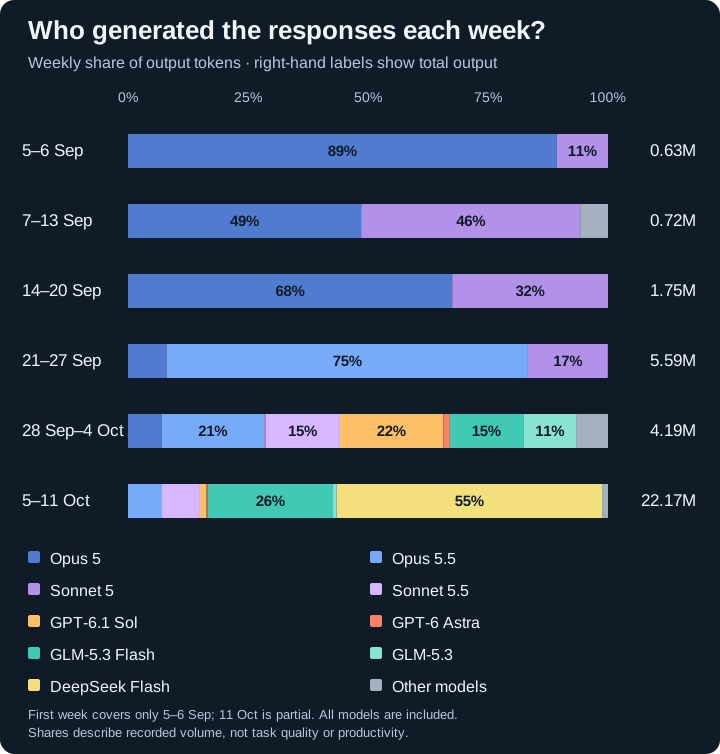
Opus 5.5 dominated output in 21–27 September; DeepSeek Flash and GLM-5.3 Flash dominated 5–11 October. This measures volume, not quality; logs do not label orchestration or delegated execution.
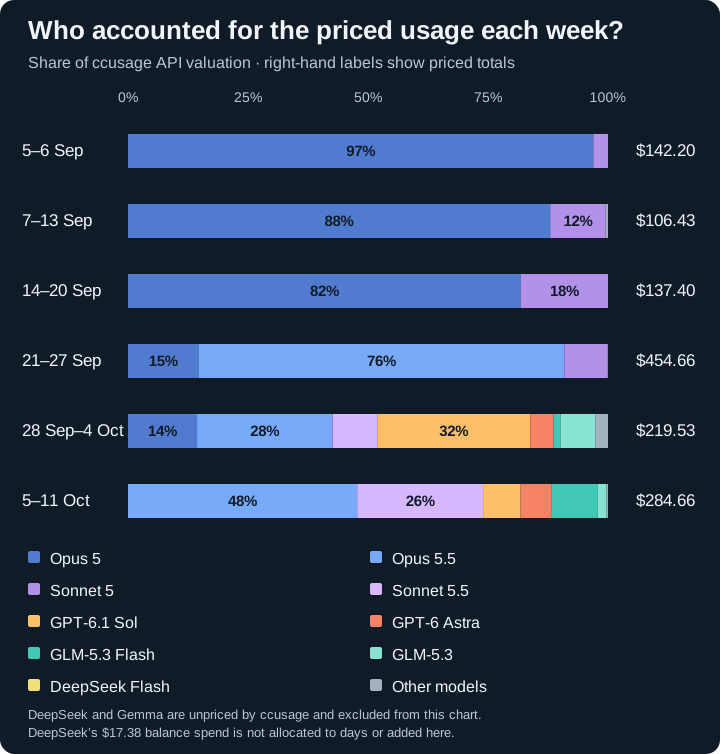
Weeks run Monday–Sunday, starting with 5–6 September. API valuation excludes unpriced DeepSeek and Gemma; DeepSeek’s balance gives no daily breakdown. Full weekly CSV.
Model totals and API prices
Below are nine of 22 models (roughly 40%), ranked by report valuation plus DeepSeek spend; GLM names differing only in case are combined.
Exact figures, dates and current-price revaluation
Dates are first and last recorded use within the snapshot, not subscription dates.
| Model | Recorded use, 2026 | Total tokens | Report USD | Current-rate scenario USD |
|---|---|---|---|---|
| Claude Opus 5.5 | 23 Sep–9 Oct | 1,271,310,516 | 544.30 | 487.51 |
| Claude Opus 5 | 5–28 Sep | 439,662,303 | 442.29 | 382.52 |
| Claude Sonnet 5.5 | 29 Sep–11 Oct | 396,364,402 | 94.90 | 83.97 |
| GPT-6.1 Sol | 1–11 Oct | 489,608,939 | 92.17 | 92.17 |
| Claude Sonnet 5 | 6–28 Sep | 217,862,861 | 82.98 | 75.05 |
| GLM-5.3 Flash | 29 Sep–9 Oct | 828,119,338 | 30.79 | 30.79 |
| GPT-6 Astra | 4–11 Oct | 16,777,705 | 28.83 | 28.83 |
| GLM-5.3 | 29 Sep–9 Oct | 60,664,035 | 21.08 | 21.08 |
| DeepSeek Flash | 6–11 Oct | 1,929,552,714 | 17.38 actual spend | 15.52–31.04 |
Prices checked 11 October 2026: Claude five-minute cache writes, OpenAI Standard/short-context rates, GLM API rates and DeepSeek off-peak/peak bounds. The two Opus models revalue to $870.03; these are not historical bills.
Exact API prices per million tokens
| Model / tier | Uncached input | Cache read | Output |
|---|---|---|---|
| Opus 5.5 | $4 | $0.20 | $20 |
| GPT-6.1 Sol, Standard / short context | $2 | $0.10 | $10 |
| GLM-5.3 Flash | $0.15 | $0.03 | $0.50 |
| DeepSeek Flash, off-peak | $0.15 | $0.003 | $0.60 |
| DeepSeek Flash, peak | $0.30 | $0.006 | $1.20 |
The table omits separately charged cache writes.
Opus versus Sonnet, Astra versus Sol
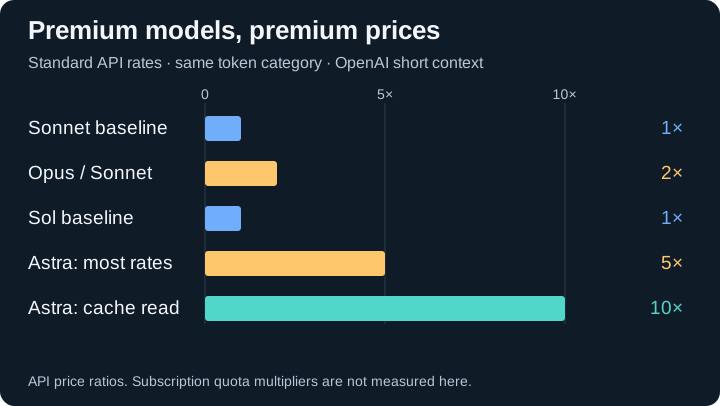
Opus costs twice Sonnet; Astra costs five times Sol, or ten times for cache reads, at the rates above. Astra’s premium is particularly steep for cached context. These logs do not measure subscription quota consumption.
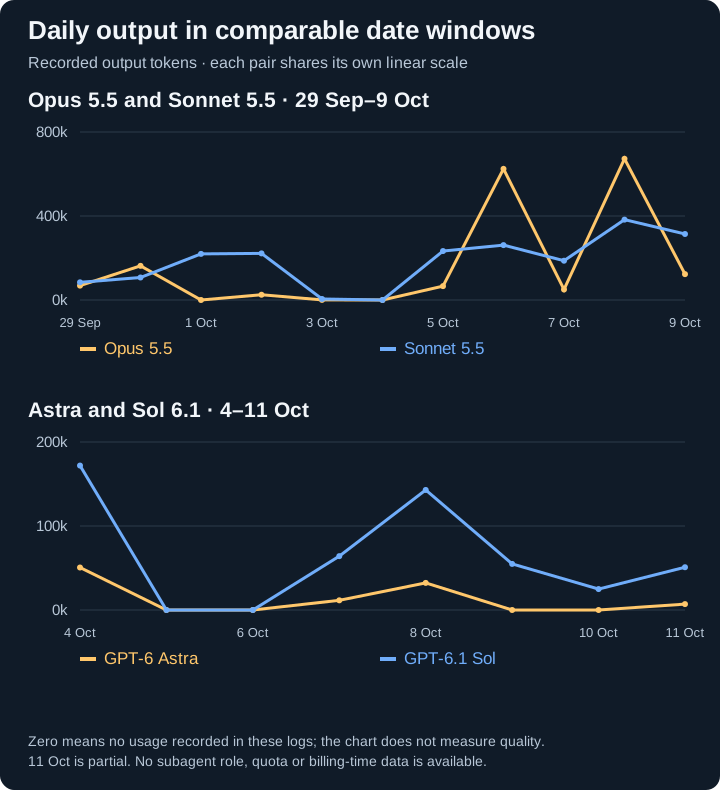
During 29 September–9 October, Opus and Sonnet had similar output per active day, but Opus’s API valuation was roughly 2.4 times higher. Their averages use nine and ten active days respectively; 4–11 October uses four for Astra and six for Sol. Astra’s valuation per active day was slightly higher than Sol’s, despite about a third of the output. An active day has a logged entry, regardless of workload. Exact paired-window calculations.

Waldemar Wosiński - Scala & Big Data engineer, father and motorcyclist ;)